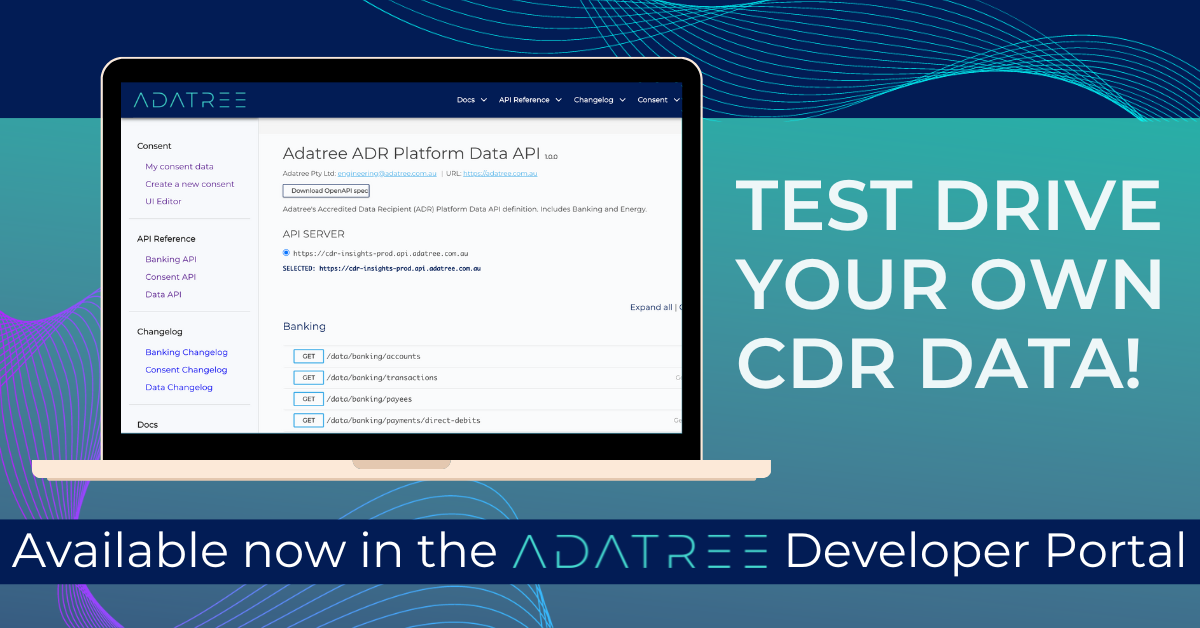
Feature release: CDR Test Drive

There’s a huge difference between having something explained to you and seeing it in action – CDR data is no different. That’s why Adatree built the ‘test-drive your CDR data’ feature into the Adatree Developer Portal. CDR Test Drive allows anyone – developers, product designers and business leaders – to consent to and connect their own CDR data and call specific CDR APIs for a first-hand experience of their CDR data and metadata. For companies interested in accessing CDR Data this can help them experience their own data payload and understand how Adatree’s Data Recipient Platform simplifies companies connecting to the CDR.
Read more

Adatree Accredited as an ADR

As of February 25, 2021, Adatree is officially accredited as an Accredited Data Recipient (ADR) by the ACCC. Adatree is the first startup to be accredited, the first company accredited with a female CEO, and the first purely CDR-focused technology provider.

Adatree is a Consumer Data Right technology provider of turnkey solutions to access and leverage CDR data, working with other companies to accelerate their own journey as an Accredited Data Recipient.

Read more

What Are the Differences Between Open Banking & Screen Scraping?

You want to build data-driven customer propositions, so how do you source that data? Historically it has been through screen scraping, but the introduction of the Consumer Data Right in Australia introduces a more reliable, customer-centric and comprehensive way to share data. 

Read more

Adatree Closes Seed Funding Round

Australian Consumer Data Right platform Adatree has closed their $1.2M Seed funding round, which was nearly three-times oversubscribed. 

Investors joining this round are Tyro Payment co-founder Peter Haig and Kerry Roxburgh, the longtime Tyro Chairman and Ramsay Health Care Director and current Chairman of Eclipx.

Read more

Open Data is Essential For Small Business Recovery

Open Banking is a financial service where customers can disclose their banking data to third parties of their choosing, giving them the freedom and control over their data. What do these changes really mean to the average person? Or, rather, to someone who is trying to save his or her small business? 

Read more